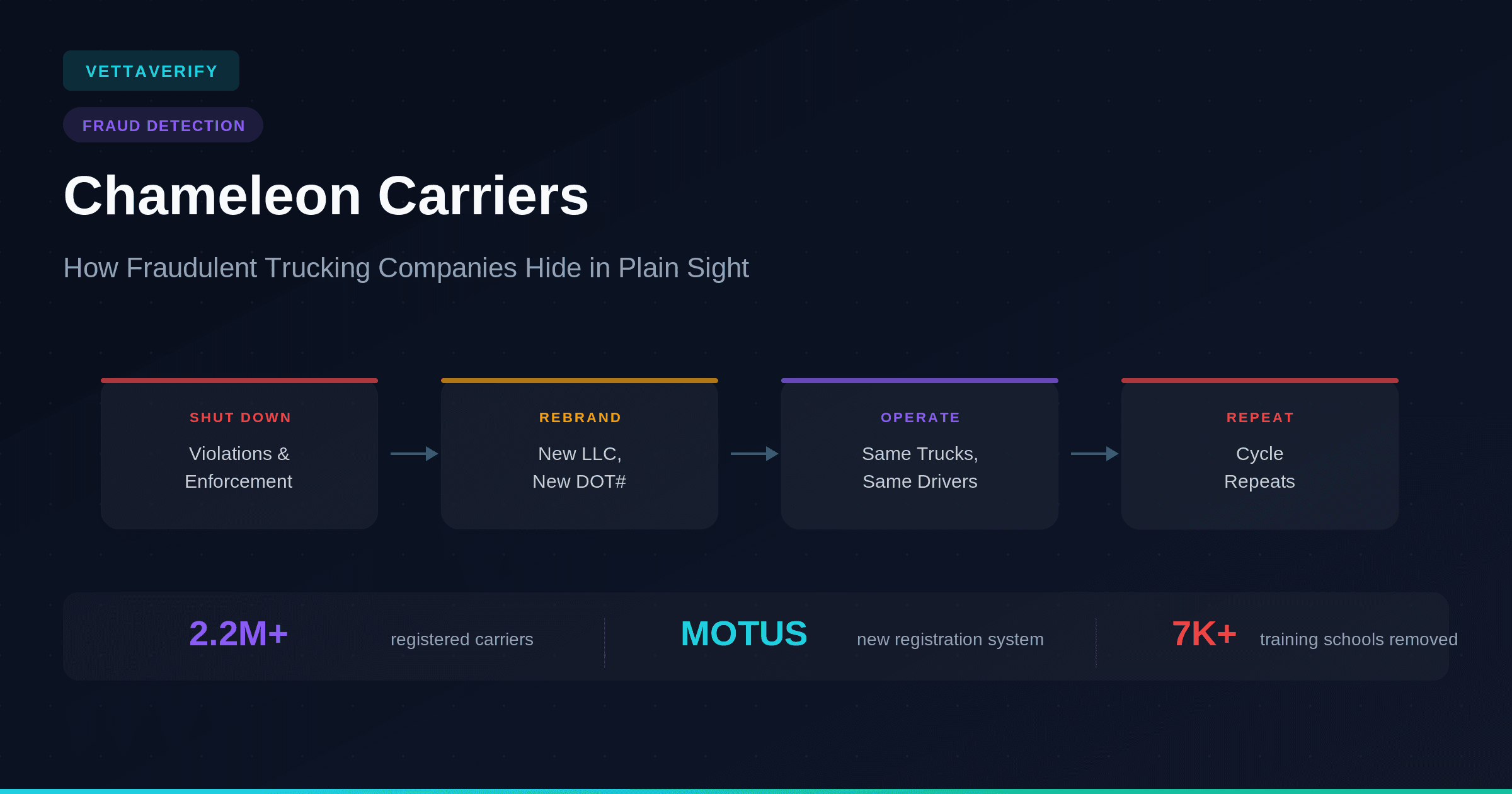
Summary: Chameleon carriers are trucking companies that shut down after enforcement action and reopen under new identities — same trucks, same drivers, clean safety record. A fatal 2026 Indiana crash exposed a network of these operators and triggered a federal crackdown. FMCSA is fighting back with the MOTUS registration system (identity verification at registration), principal place of business enforcement (ending "ghost offices"), data-driven risk scoring, and CDL/ELD fraud actions. For brokers, protection means looking beyond the SAFER snapshot, monitoring carriers continuously, cross-referencing data points like VINs and addresses across the full FMCSA database, and verifying identity — not just documentation.
In February 2026, a fatal crash in Indiana involving an unauthorized truck driver pulled back the curtain on something the freight industry has been dealing with for years: chameleon carriers. The driver's company turned out to be part of a network of carriers that, in the words of Transportation Secretary Sean Duffy, "swap names and DOT numbers to avoid enforcement."
The incident triggered a cascade of federal action — new legislation, FMCSA enforcement announcements, and a public reckoning with just how deeply these operators have embedded themselves in the freight system. For freight brokers, especially small and mid-size shops without dedicated compliance teams, understanding chameleon carriers isn't optional anymore. It's a core part of doing business safely in 2026.
What Is a Chameleon Carrier?
A chameleon carrier is a trucking company that shuts down after receiving safety violations, enforcement actions, out-of-service orders, or regulatory penalties — and then reopens under a new name, new USDOT number, or new corporate structure. The equipment, drivers, and operations stay the same. Only the paperwork changes.
The term has been used in the industry for over a decade, but the practice has accelerated dramatically. The underlying logic is simple: if FMCSA shuts you down for safety violations, getting a fresh identity is cheaper and faster than fixing the violations. Register a new LLC, apply for a new USDOT number, and you're back in business — often within days — with a clean safety record.
The problem is compounded by the sheer scale of the registration system. FMCSA oversees more than 2.2 million registered carriers. Processing new applications quickly is necessary to keep the freight economy moving, but it also creates openings for bad actors who know how to game the system.
How Chameleon Carriers Actually Operate
The mechanics vary in sophistication, but most chameleon carrier schemes follow a recognizable pattern.
The Basic Playbook
A carrier accumulates safety violations, failed inspections, or out-of-service orders. When enforcement action becomes imminent — or after it's already been issued — the operator shuts down the company. They then register a new entity, often in the name of a family member, business associate, or shell company. The new entity applies for a fresh USDOT number and, until recently, a new MC number. Once approved, the same trucks, the same drivers, and the same unsafe practices are back on the road under a clean identity.
Ghost Offices and Mail Drops
Many chameleon carriers register their principal place of business at addresses that aren't real offices. P.O. boxes, virtual mailbox services, and shared addresses where dozens or even hundreds of USDOT numbers are registered have been common. These "ghost offices" make it nearly impossible for FMCSA investigators to locate the actual operation or inspect records.
FMCSA Administrator Derek Barrs has called ending ghost offices a top priority, noting that carriers must now maintain a verifiable physical location where records can be inspected within 48 hours.
Identity Theft and Carrier Impersonation
The more sophisticated variant goes beyond creating new identities — it involves stealing existing ones. Criminals hijack the email addresses, phone numbers, or FMCSA SAFER profiles of legitimate carriers and use that stolen identity to book loads. In the Tanager Logistics case that was central to last year's Senate hearing, fraudsters created a completely fake version of a real company, added it to FMCSA's SAFER website, and brokered loads under the legitimate company's name.
This is where chameleon carriers and double brokering intersect. A fraudulent entity operating under a stolen or fabricated identity books a load from a broker, then either re-brokers it (double brokering), diverts it to a warehouse for resale, or simply disappears with the freight.
Network Structures
The Indiana crash investigation revealed that chameleon carriers often don't operate alone. They form networks of affiliated entities — multiple shell companies, each with its own USDOT number, sharing drivers, equipment, addresses, and phone numbers. When one entity gets shut down, the others absorb its operations. FMCSA's Barrs described these as operators running multiple DOT numbers specifically designed to avoid enforcement and compliance.
Why It's Getting Worse
Several converging factors have made 2026 a peak year for chameleon carrier activity.
Outdated Registration Systems
FMCSA's registration infrastructure was built decades ago and was never designed to handle the kind of identity fraud that's now commonplace. Until the MOTUS modernization effort began rolling out in late 2025, the system lacked meaningful identity verification at the point of registration. Applicants could provide minimal information, and the system had limited ability to cross-reference new applications against shut-down entities.
Dual MC/USDOT Number System
The existence of both MC numbers and USDOT numbers has created confusion and exploitable redundancy. Chameleon carriers have leveraged this dual-system to create new identities while maintaining some continuity in their operations. The SAFER Transport Act's proposal to phase out MC numbers over five years is a direct response to this problem.
Weak Penalty Enforcement
A 2019 legal ruling stripped FMCSA of its explicit authority to assess civil penalties for unauthorized brokerage activities. Without the ability to impose fines directly — forcing the agency to route enforcement through the Department of Justice — response times have been slow and consequences inconsistent. Legislation currently advancing in the Senate (the Household Goods Shipping Consumer Protection Act) would restore this authority.
High Rewards, Low Risk
The economics of freight fraud remain attractive. A single diverted load can be worth six figures. The penalties, when they come at all, rarely match the potential payoff. For organized criminal operations — including those with international ties — the freight industry represents a high-value, low-risk target.
What FMCSA Is Doing About It
To its credit, FMCSA has moved more aggressively on chameleon carriers in the past year than at any point in the agency's history.
The MOTUS Registration System
MOTUS is FMCSA's modernization of its registration platform, replacing a 40-year-old system. The initial rollout began in December 2025, with additional phases planned throughout 2026. The system adds identity verification and business validation at the point of registration, including AI-supported identity checks designed to flag connections between new applications and previously shut-down entities.
The underlying philosophy is straightforward: tighten the front door. If it's harder to get a fraudulent registration through the system in the first place, the downstream problems — chameleon carriers, identity theft, double brokering — become more difficult to execute.
Principal Place of Business Enforcement
FMCSA is restoring enforcement around carrier addresses, requiring that registered principal places of business be real, physical locations tied to actual management and safety oversight. Carriers must be able to produce records for inspection within 48 hours at their registered address. The agency has signaled that ghost offices — mail drops, P.O. boxes, shared addresses with hundreds of registrations — will be treated as fraud indicators.
Data-Driven Risk Scoring
A leaked DOT memo revealed that the agency is developing a "data-driven severity matrix" that would assign risk scores to carriers based on behavioral patterns. The indicators include shared addresses and contact information across multiple entities, rapid re-registration after enforcement action, and other patterns consistent with identity manipulation.
This approach mirrors what the industry's private-sector vetting platforms have been doing for years — and it validates the thesis that data-driven risk assessment is the most effective way to catch fraud that traditional document checks miss.
CDL and Training Crackdowns
FMCSA has removed over 7,000 training schools from its Training Provider Registry since 2025 and has been conducting sting operations targeting CDL mills and corrupt third-party testers. The agency is also pushing states to revoke CDLs (rather than just issuing temporary out-of-service orders) for drivers who fail English Language Proficiency requirements. Over 14,000 drivers have received ELP violations so far.
ELD Enforcement
The agency has purged 42 non-compliant electronic logging devices from the approved list and blocked 238 new ELDs from self-certifying. Fraudulent ELD use — tampering with devices to falsify Hours of Service records — has been a tool for both chameleon carriers and their drivers.
How Freight Brokers Can Protect Themselves
FMCSA's enforcement is getting better, but it will never be sufficient on its own. The agency oversees 2.2 million carriers with limited resources, and even the best registration system can be gamed. Brokers need their own defenses.
Watch for the five red flags of double brokering when evaluating new carriers.
Look Beyond the SAFER Snapshot
FMCSA's SAFER website provides a point-in-time view of a carrier's registration status. It doesn't tell you what changed last week, whether the carrier's contact information was recently modified, or whether the entity shares an address with 50 other USDOT numbers. Chameleon carriers exploit the gap between what SAFER shows and what a deeper investigation would reveal.
Effective vetting requires looking at the full picture: authority history, insurance continuity, inspection patterns, geographic activity, fleet composition, and — critically — how those data points have changed over time. A carrier that had zero inspections six months ago and now shows activity across 15 states is a different risk profile than one with a consistent regional pattern.
Monitor Continuously, Not Just at Onboarding
Most brokerages vet carriers when they first onboard them and then never check again. This is a fundamental gap that chameleon carriers and identity thieves exploit. A carrier's profile can change between loads — authority can be revoked, insurance can lapse, ownership can transfer, and contact information can be hijacked.
Continuous monitoring — automated alerts when a carrier in your network experiences a material change — is the only way to catch problems before they become losses.
Cross-Reference Data Points
Chameleon carriers often leave traces across the data that a manual review would miss but an automated system can catch. The same phone number appearing on multiple USDOT registrations. An address that matches a recently shut-down carrier. Insurance policies with unusually short coverage periods. VIN numbers associated with carriers that have been flagged or deactivated.
Cross-referencing these data points — especially across the full FMCSA database rather than just a single carrier's profile — dramatically increases your ability to detect fraud before it costs you a load.
Verify Identity, Not Just Documentation
Documents can be forged. A valid-looking insurance certificate, a plausible carrier packet, and a professional-sounding dispatcher are not proof that you're talking to who you think you're talking to. Identity verification — confirming that the person representing a carrier actually works for that carrier, using methods that are hard to spoof — is the layer that separates document-level vetting from genuine fraud prevention.
Phone verification, email domain checks against FMCSA records, and ELD-based location confirmation all contribute to identity confidence. No single check is sufficient, but layered verification makes impersonation significantly harder.
Document Everything
The Kowalski Act and Miller v. C.H. Robinson precedent both point toward holding brokers responsible for the carriers they choose. If a carrier you booked turns out to be a chameleon carrier or a double-brokering operation, you'll need to demonstrate that your vetting process was reasonable and well-documented. "We checked SAFER and it looked fine" is no longer an adequate defense.
Every carrier approval, rejection, flag, and override should be recorded with a timestamp, the data reviewed, and the rationale for the decision. This isn't just good compliance practice — it's your legal protection.
How VettaVerify Helps
VettaVerify was designed with exactly this threat model in mind. The platform syncs with the full FMCSA database daily — including census data, inspection records, crash history, fleet information, and insurance status — and runs automated change detection on every carrier. When a carrier's authority status changes, their contact information shifts, their insurance lapses, or their safety profile deteriorates, brokers in the platform are alerted automatically.
VettaScore, the platform's proprietary risk rating, incorporates dozens of data points — out-of-service rates, violation frequency, geographic anomalies, authority age and status, crash indicators, and more — into a single 0-100 score that's refreshed nightly. It's the kind of data-driven severity matrix that FMCSA itself is now building, but available today for brokers who need it.
The carrier search also supports cross-referencing: VIN lookups across the entire FMCSA database can reveal whether a vehicle is associated with flagged or deactivated carriers, a pattern common in chameleon carrier networks.
For small and mid-size brokerages, the bottom line is this: chameleon carriers are getting more sophisticated, but the tools to detect them are getting better too. The brokers who invest in real carrier intelligence — not just a quick SAFER check — are the ones who won't be writing off six-figure losses to a carrier that technically didn't exist.
VettaVerify gives small and mid-size freight brokerages enterprise-grade carrier intelligence — real-time FMCSA data, automated change tracking, VettaScore risk ratings, and VIN cross-referencing — starting at $59/month. See how it works.