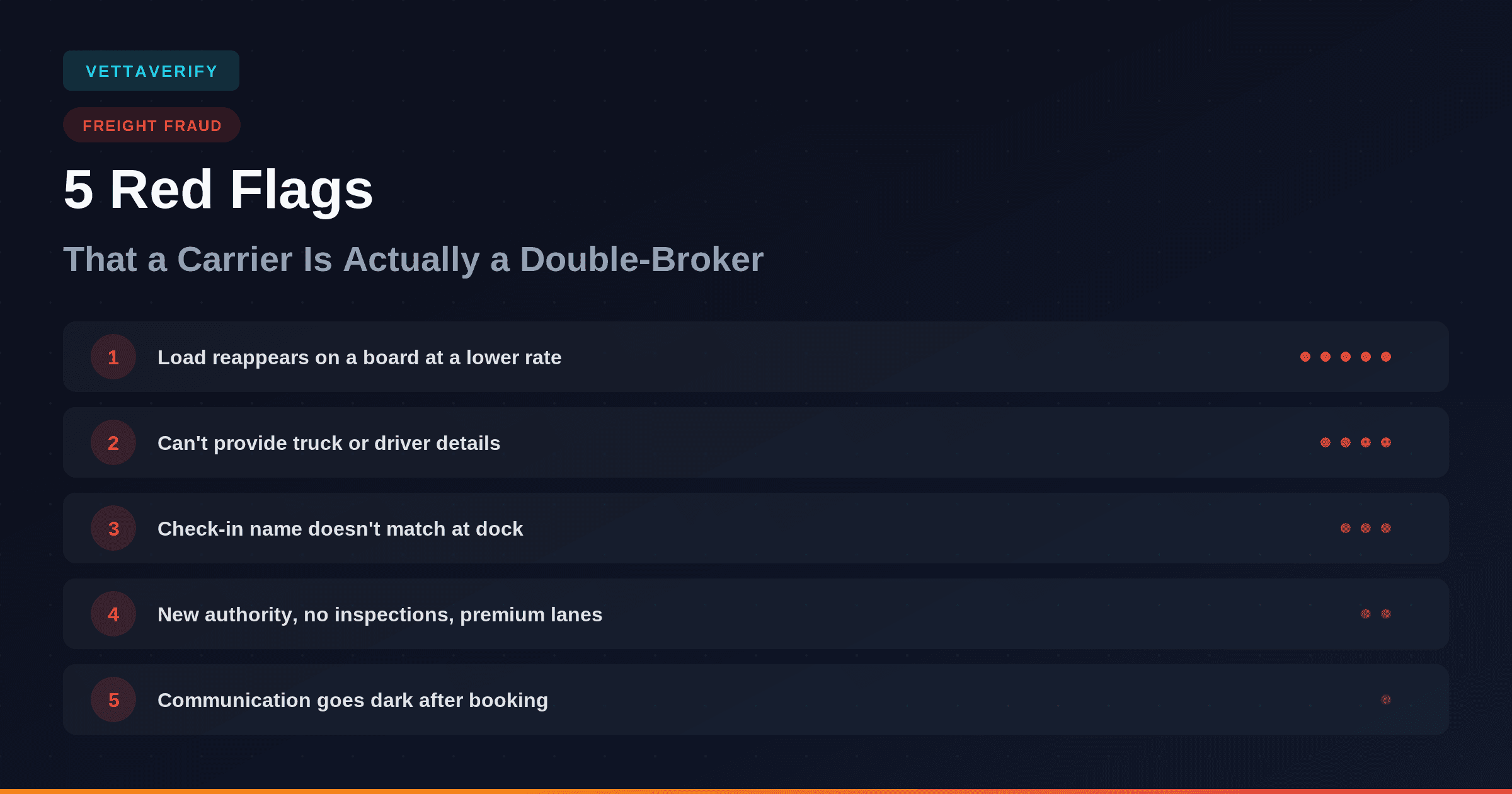
Summary: Double-brokering complaints have risen 400%+ since 2022 and cost the industry hundreds of millions annually. The five biggest warning signs: (1) your load reappears on a board at a lower rate shortly after booking, (2) the carrier can't provide specific truck or driver details, (3) the check-in name at the shipper's dock doesn't match, (4) the carrier has a brand-new authority with zero inspection history but is bidding on premium lanes, and (5) communication goes dark after booking. No single flag is proof — but when they stack, hold the load and investigate. Layered verification (authority age + inspections + fleet data + insurance + ELD confirmation) is the most effective defense.
Double brokering remains the most financially damaging fraud vector in freight. It's also the one that small brokerages are most likely to encounter — not because they're careless, but because the scams have gotten genuinely difficult to spot.
The mechanics haven't changed: a fraudulent entity poses as a carrier, accepts your load, and then re-brokers it to an actual carrier at a lower rate. The real carrier delivers the freight. The shipper pays you. You pay the entity you think is the carrier. That entity disappears with the money and never pays the actual carrier. Now you've got an unpaid trucker, a furious shipper, and an insurance gap on a load that was moved by someone who was never on your approved list.
The Transportation Intermediaries Association estimates that double brokering costs the industry hundreds of millions of dollars every year. Since 2022, double-brokering complaints have risen by over 400% according to Truckstop data. And because the actual freight still moves — the load isn't stolen, just misrouted financially — the scam can go undetected for days or even weeks.
Here are the five most reliable warning signs that a carrier you're about to book isn't actually going to haul the load.
Red Flag #1: The Load Reappears on a Board at a Lower Rate
This is the most visible indicator, and it's one your team should train themselves to watch for.
You post a load on a board at a certain rate. A carrier accepts it. Then, within hours — sometimes within minutes — the same load appears elsewhere, reposted at a lower rate, often on a different board or in a different format.
What's happening is straightforward: the double broker accepted your load at your rate, and is now shopping it to an actual carrier at a lower price. The spread between what you're paying and what the real carrier gets hauled for is the double broker's profit. On high-value lanes during peak demand, that spread can be substantial.
What to do about it: If you see a load that matches yours reposted at a lower rate shortly after booking, contact the carrier who accepted your load immediately. Ask them to confirm the truck number, driver name, and pickup location. If they can't provide specifics, or if the details don't match, you likely have a double-brokering situation. Some brokers also use load board alerts to monitor for repostings — it's an imperfect tool, but it catches the obvious cases.
Red Flag #2: The Carrier Can't Provide Specific Truck or Driver Details
Legitimate carriers know their trucks. When you book a load with a real carrier — even a small one-truck operation — they can tell you the truck number, trailer number, and driver name. Often they can tell you right away. At most, they need a few hours to confirm the driver assignment.
Double brokers don't have this information because they don't have trucks. When pressed, they'll stall. Common deflection tactics include "the dispatcher will send that over later," "we're still confirming the driver assignment," or "I'll have that for you by pickup time." Some will provide details that turn out to be fabricated — a truck number that doesn't match the carrier's fleet, a driver whose name doesn't appear on the carrier's FMCSA record.
What to do about it: Make truck and driver confirmation a mandatory pre-pickup step. Set a clear deadline — at least a few hours before pickup — for the carrier to provide the truck number, driver name, and driver phone number. Cross-check the truck number against the carrier's known fleet where possible. If the information doesn't come, or if it doesn't match, hold the load and investigate before the freight leaves the dock.
Red Flag #3: The Check-In Name Doesn't Match
This red flag shows up at the shipper's dock. Your load was booked under Carrier A, but the driver who arrives to pick it up checks in under a different name — a different carrier, a different MC number, or a different individual.
When a double broker re-brokers your load, the actual carrier who shows up to haul it may not even know that a double broker is involved. They think they were booked directly. So they check in at the shipper under their own name, their own carrier authority, and their own documentation. The mismatch between the carrier on your paperwork and the carrier at the dock is a clear sign the load was re-brokered.
Similarly, if the Bill of Lading lists a broker name or carrier name that you don't recognize, that's a strong signal that an intermediary inserted themselves into the transaction.
What to do about it: Coordinate with your shippers to flag any discrepancies between the carrier name on the BOL and the carrier they were expecting. Some brokers implement a "carrier verification at pickup" protocol where the shipper confirms the driver's carrier authority before releasing freight. This adds a small step to the pickup process but catches double-brokering at the moment it matters most — before the load leaves the dock.
Red Flag #4: New Authority, No Inspection History, Premium Lanes
On its own, a newly registered carrier authority isn't a red flag. New carriers enter the market every day, and many are legitimate operations getting their start. But a newly issued authority combined with specific behaviors should raise your alert level significantly.
Watch for carriers with authority less than 90 days old that are requesting high-value, long-haul loads on premium lanes. Legitimate new carriers typically start with shorter hauls, lower-value freight, and familiar territory. A brand-new MC number bidding aggressively on a $20,000 reefer load from California to New York is not how most carriers build their business.
Also pay attention to the absence of inspection history. A carrier that's been operating for several months should have at least some roadside inspections on record. Zero inspections combined with aggressive load acquisition suggests the entity isn't actually hauling freight — it's brokering it.
The SAFER Transport Act is addressing this registration gap at the federal level.
What to do about it: Establish clear criteria for how you handle new-authority carriers. Many brokerages require a minimum authority age (90 days, 180 days, or even a year) before booking loads. Others will work with newer carriers but require additional verification: confirmed insurance with a direct call to the insurer, ELD data showing actual truck activity, or references from other brokers who have used them successfully.
Risk scoring can help here. A carrier with a 30-day-old authority, zero inspections, and no fleet data is a very different risk profile than one with a 30-day-old authority, a few inspections, registered power units, and ELD data showing daily activity. The more data points you can layer into the assessment, the better your ability to separate a legitimate new entrant from a shell entity.
Red Flag #5: Communication Goes Dark After Booking
Double brokers are often responsive and professional during the booking process. They need to be — their entire operation depends on getting you to hand over the load. But once the load is booked and they've re-brokered it to an actual carrier, their incentive to communicate with you drops sharply.
Watch for a pattern where the carrier was quick to respond during rate negotiation and booking confirmation, but becomes unreachable once the load is in transit. Calls go to voicemail. Check-call responses come in late or not at all. Updates on delivery status are vague or recycled from tracking data rather than direct communication with the driver.
This happens because the double broker doesn't have direct contact with the actual driver. They're relying on the real carrier for updates and relaying them — if they bother at all. In many cases, the double broker's plan is to collect payment and disappear before the communication breakdown becomes obvious.
What to do about it: Require direct driver contact information at booking — not just a dispatch number. If the carrier can only provide a dispatch number and claims the driver doesn't have a phone, that's suspicious in 2026. Make check-calls directly to the driver, not just to the dispatch number the carrier provided.
ELD-based tracking is even more effective. If the carrier provides ELD access and you can see the truck's real-time location, it becomes much harder for a double broker to maintain the illusion. The truck is either where it should be or it isn't. And if the carrier refuses to provide ELD access or claims their system is down, that itself is a data point worth weighing.
The Bigger Picture: Layered Verification
No single red flag is definitive proof of double brokering. A new carrier can be legitimate. A dispatcher who's slow to respond might just be having a bad day. A load that appears on another board might be a coincidence.
What makes these signals actionable is when they stack. A newly registered authority, with no inspection history, that can't provide truck details, and goes dark after booking is not a coincidence. It's a pattern, and it should trigger an immediate hold on the load until the situation is resolved.
The most effective defense against double brokering is layered verification — combining multiple data points into a single assessment before the freight ever leaves the dock. Authority age. Inspection history. Fleet data. Insurance verification. Contact validation. ELD confirmation. Each layer independently catches a different subset of fraud. Together, they make it extraordinarily difficult for a double broker to pass.
For a deeper dive into fraud prevention strategies, see our practical prevention guide for small brokerages.
How VettaVerify Makes This Easier
Building this layered verification manually — pulling FMCSA data, calling insurance providers, cross-checking fleet records, monitoring load boards — is possible, but it's slow and it doesn't scale. For a small brokerage running dozens of loads a week, doing deep verification on every carrier isn't realistic without tools that automate the heavy lifting.
VettaVerify consolidates the data points that catch double brokers into a single carrier profile. VettaScore weighs authority age, inspection frequency, out-of-service rates, geographic anomalies, and dozens of other factors into a composite risk rating that flags exactly the kind of carriers that raise the red flags described above. The platform's FMCSA data syncs daily, so insurance lapses, authority changes, and fleet data are always current.
For Pro and Enterprise tier brokers, ELD integration through Terminal provides real-time location verification — letting you confirm that a carrier's truck is actually where they say it is, not just taking their word for it.
The goal isn't to eliminate risk entirely — that's not possible in freight. The goal is to make your vetting good enough that the scams that would catch a less-prepared brokerage off guard never make it past your front door. Five red flags, consistently watched for, is a strong start. A platform that automates the watching is how you sustain it at scale.
VettaVerify helps freight brokers catch fraud before it costs them freight. Real-time carrier intelligence, VettaScore risk ratings, ELD integration, and automated change monitoring — built for brokerages that can't afford to lose a single load. Try it free.