Last year, a small brokerage in the Midwest lost $180,000 in a single week to a double-brokering ring. Three loads, three different "carriers," same fraud operation. By the time they realized what happened, the freight was gone and the MC numbers had been deactivated. Stories like this are no longer rare — the scale, sophistication, and velocity of freight fraud in 2025 and 2026 is something the industry hasn't seen before.
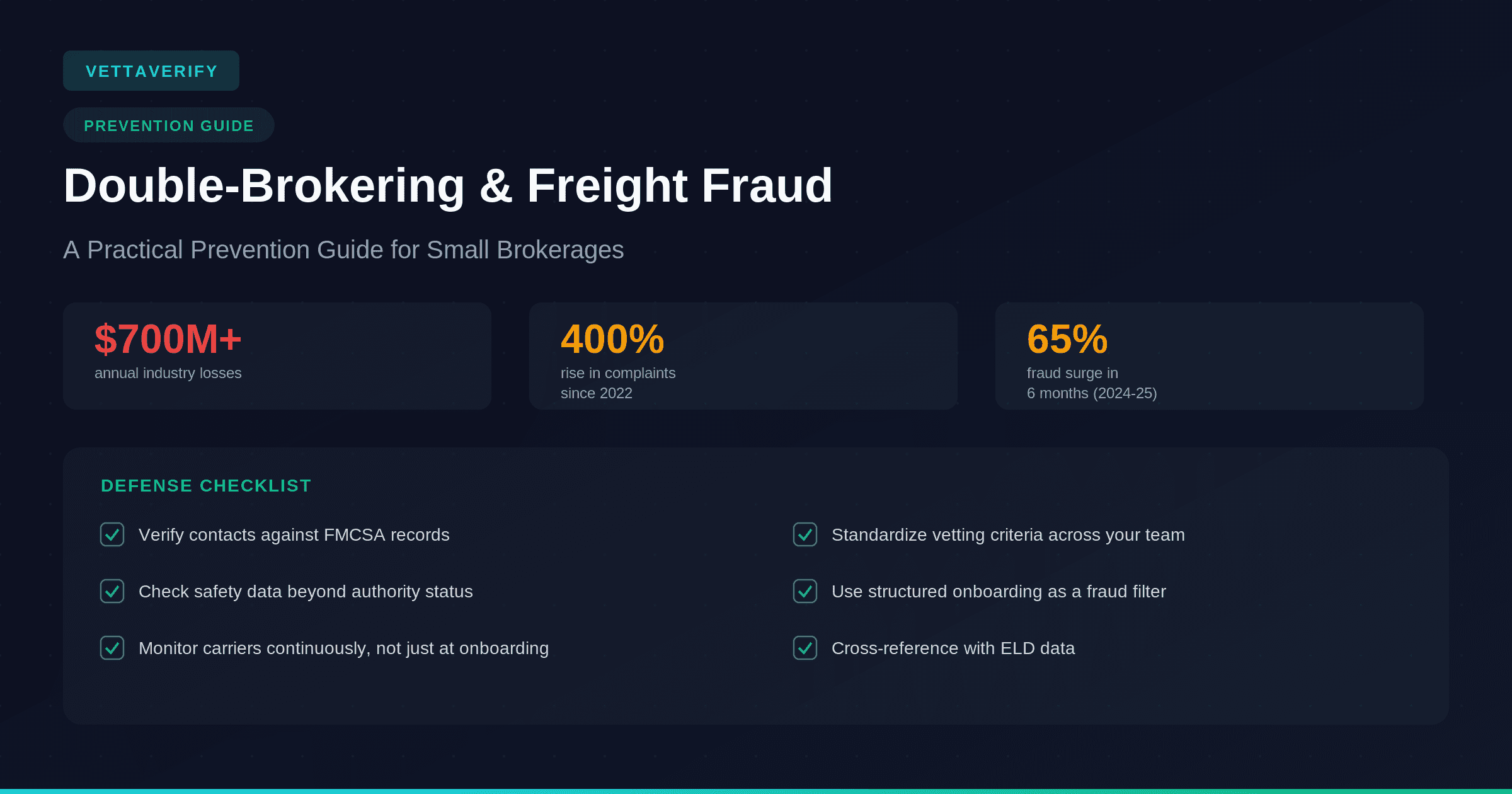
Double-brokering reports have increased more than 400% since 2022. Fraud reports surged 65% between September 2024 and February 2025 alone. The estimated annual losses from cargo theft and fraud now exceed $700 million industrywide. And small brokerages — the ones without dedicated compliance teams or enterprise fraud detection tools — are disproportionately targeted.
This isn't a guide about being paranoid. It's a guide about being practical.
How Double-Brokering Actually Works
At its simplest, double-brokering happens when a carrier accepts a load from your brokerage and then, instead of hauling it themselves, re-brokers it to another carrier — often without your knowledge or the shipper's consent.
The mechanics are straightforward. A carrier (or someone posing as a carrier) books a load through your brokerage. They accept the rate, confirm the pickup, and provide tracking information. But instead of dispatching their own driver, they post the load on a load board at a lower rate and hand it off to a different, often unvetted carrier. They pocket the difference.
In the best case, the freight still gets delivered and you never know it happened. In the worst case — which is increasingly common — the actual carrier is uninsured, unvetted, or outright criminal. The freight disappears, and you're left holding the bag for a load that was hauled by someone you never approved.
The more sophisticated operations go further. They steal the identity of legitimate carriers, spoofing phone numbers and email addresses to pass basic verification checks. They create chameleon carriers — new MC numbers registered with minimal history, designed to look just established enough to pass a cursory FMCSA check. And they operate at scale, running dozens of fraudulent bookings simultaneously before disappearing and resurfacing under a new identity.
Why Small Brokerages Are the Primary Target
Fraud operations target the path of least resistance, and for most of them, that path leads straight to small and mid-size brokerages.
The logic is simple. Enterprise brokerages have dedicated compliance teams, automated vetting platforms, and multi-step verification processes that make fraud more difficult and less profitable. A 10-person brokerage checking carriers manually through FMCSA SAFER and a quick phone call? That's a much easier mark.
Small brokerages also tend to have thinner margins and less financial cushion to absorb losses. A single $100,000 double-brokering incident that would be a rounding error for a top-25 brokerage could be a business-ending event for a small one. Fraudsters know this and exploit it.
The time pressure of freight brokerage makes things worse. When a shipper needs a carrier in two hours and your dispatcher has three other loads to cover, the incentive to cut corners on vetting is enormous. Fraud operations are designed to exploit exactly this dynamic — presenting themselves as available, affordable, and ready to go when you're under the gun.
The Red Flags That Matter
The most reliable warning signs tend to cluster around a few categories.
Contact information mismatches. When a carrier's phone number, email address, or physical address doesn't match what's registered with FMCSA, that's worth investigating. Legitimate carriers occasionally update their contact info and forget to file the change, but identity thieves frequently operate using contact details that don't match the FMCSA record because they've hijacked someone else's MC number.
New authority with no inspection history. A carrier that received their operating authority last month and has zero roadside inspections on record isn't necessarily fraudulent — they might genuinely be a new operation. But new authority plus no inspections plus eagerness to book loads at below-market rates is a combination that deserves serious scrutiny.
Geographic inconsistencies. A carrier registered in one region with all their activity happening in a completely different part of the country may have a legitimate explanation (they relocated, they run dedicated lanes). Or they may be a chameleon carrier operating under a freshly obtained MC number in a region far from where the original carrier was based.
Rate undercutting. Carriers that consistently accept loads at significantly below-market rates are either desperate or not planning to haul the load themselves. While rate shopping is normal, a carrier that's 20% below every other quote on a lane should raise questions about whether they intend to double-broker.
Communication patterns. Pay attention to how a carrier communicates. Are they eager to book but evasive about providing documentation? Do they push back on verification steps? Do their dispatchers seem unfamiliar with basic details about their own operation? Legitimate carriers welcome verification because it's in their interest to demonstrate trustworthiness.
Practical Prevention Steps
Protecting your brokerage from freight fraud doesn't require an enterprise budget. It requires consistent processes and the right tools. Here's what actually works.
Verify contact information against FMCSA records. Before booking a load with any carrier, confirm that the phone number, email, and address they're using match what's on file with FMCSA. This single step catches a surprising number of identity theft operations, because the fraudster is using contact details that differ from the legitimate carrier's FMCSA filing.
Check more than authority status. An active MC number and valid insurance are necessary but insufficient. Look at safety performance data — out-of-service rates, violation history, crash records. Look at how long they've held authority. Look at their inspection history and where those inspections occurred. A carrier that passes the "are they legally allowed to operate?" test might still fail the "should I trust them with my shipper's freight?" test.
Monitor continuously, not just at onboarding. A carrier you vetted and approved six months ago isn't the same carrier today. Insurance lapses, safety rating changes, authority revocations, new violations — these happen constantly, and if you're only checking carriers once, you're missing everything that changes afterward. Automated monitoring that alerts you to material changes in your carrier network is one of the highest-value investments a small brokerage can make.
Standardize your criteria. When vetting is ad hoc — different dispatchers applying different standards based on time pressure and personal judgment — your fraud exposure is unpredictable. Define clear, written criteria for what makes a carrier acceptable. Apply those criteria consistently. When a carrier doesn't meet your standards, document why and move on, regardless of how urgent the load is.
Use carrier onboarding as a filter. Require carriers to complete a structured onboarding process before they can book loads. Collect insurance certificates, verify driver information, confirm equipment details, and get agreements signed. Fraudulent carriers rarely invest time in completing a thorough onboarding process because they're optimizing for speed and volume, not long-term relationships. A robust onboarding workflow acts as a natural filter against the most common fraud schemes.
Cross-reference with ELD data. If a carrier claims to have a certain number of trucks in a certain location, ELD data can verify that. Carriers who can demonstrate real-time vehicle locations through an ELD integration are materially more trustworthy than those who can't — because fabricating ELD data at scale is significantly harder than fabricating a carrier profile.
Building a Culture of Vigilance
The most effective fraud prevention isn't a tool or a checklist — it's a culture. Your dispatchers and ops team need to understand that vetting isn't a bureaucratic obstacle. It's the thing that keeps the brokerage alive.
That means giving them the time and tools to do it properly. If your team is so slammed that they're cutting corners on verification to hit load targets, the problem isn't laziness — it's a workflow that doesn't scale. Automating the routine checks frees your people to focus on the judgment calls that actually require human expertise.
The Kowalski Act would codify broker liability for these failures.
It also means creating an environment where flagging a suspicious carrier is rewarded, not punished. If a dispatcher raises a concern about a carrier and gets pushback because "we need to cover this load now," you've just taught your team that speed matters more than safety. That lesson will eventually cost you far more than the one load you missed.
The Landscape Ahead
Freight fraud isn't going away. As long as there's money in moving freight, there will be people trying to steal it. But the tools available to small brokerages have improved dramatically.
Automated carrier vetting, continuous monitoring, risk scoring, digital onboarding, and ELD verification are no longer enterprise-only capabilities. They're accessible at price points that make sense for a 10-person brokerage. The playing field is leveling, and the brokerages that adopt these tools aren't just protecting themselves from fraud — they're building the operational infrastructure that shippers, regulators, and insurers increasingly expect.
See also our breakdown of the 5 red flags that a carrier is actually a double-broker for quick reference.
The best defense against freight fraud is also the best offense for growth: knowing exactly who you're working with, every time, on every load.