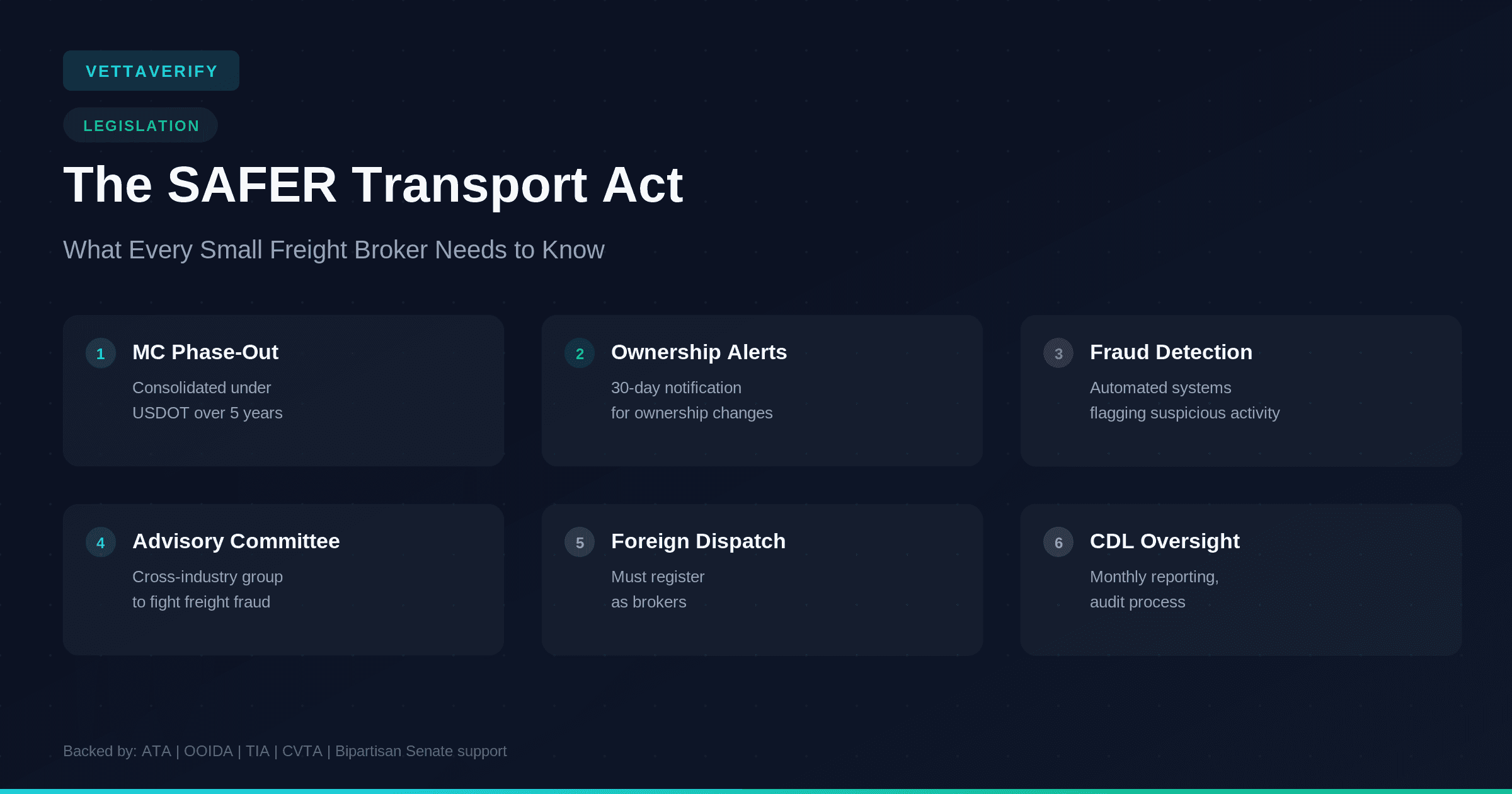
Summary: The SAFER Transport Act, introduced in the Senate on February 26, 2026, is the most comprehensive freight fraud bill in years. It would phase out MC numbers over five years, require ownership change notifications within 30 days, mandate automated fraud detection in FMCSA's registration system, establish a Freight Fraud and Theft Advisory Committee, and require foreign dispatch services to register as brokers. The bill has broad industry support from ATA, OOIDA, and TIA. Small brokers should start orienting vetting around USDOT numbers, implementing continuous carrier monitoring, and building documented compliance trails now — the regulatory direction is clear regardless of this bill's timeline.
On February 26, 2026, Senator Todd Young introduced the Securing American Freight, Enforcement, and Reliability in Transport Act — better known as the SAFER Transport Act — to the U.S. Senate. It is, by a wide margin, the most comprehensive piece of freight fraud legislation to reach Congress in recent memory.
If you run a small or mid-size brokerage, this bill matters. Not eventually. Now. Here's what it says, what it changes, and what you should be doing about it.
Why This Bill Exists
The freight fraud problem isn't new, but it has reached a scale that Congress can no longer ignore. The American Transportation Research Institute estimates that cargo theft alone costs the trucking industry over $18 million per day. Strategic theft — the kind that uses identity manipulation, double brokering, and cyber fraud to divert loads — has surged more than 1,500% since 2021.
The trigger for this particular bill was a Senate Commerce Subcommittee hearing chaired by Senator Young last year, where a small fleet owner named Adam Blanchard testified about having his company's identity stolen. Criminals created a fake version of his logistics company, added the bogus entity to FMCSA's own SAFER website, and used it to broker loads under his name. The real company spent months playing whack-a-mole while the scammers pocketed the money. When Blanchard contacted FMCSA about the impersonation, the agency refused to remove the imposter from its site.
That testimony — and hundreds of similar stories from small carriers and brokers — became the foundation for the SAFER Transport Act.
What the Bill Actually Does
The SAFER Transport Act is not a single-issue bill. It attacks freight fraud, registration integrity, CDL oversight, and enforcement gaps simultaneously. Here are the provisions that matter most for brokerages.
Freight Fraud and Theft Advisory Committee
The bill establishes a new advisory committee within 60 days of passage. The committee would include motor carriers, owner-operators, brokers, shippers, insurers, and law enforcement. Its mandate: deliver recommendations within two years for reducing freight fraud and improving coordination between federal, state, and local agencies.
This is significant because one of the biggest complaints from industry — echoed by Blanchard's testimony — is that there's no clear authority or coordination when fraud happens. Victims report to FMCSA, the DOT Inspector General, local police, and sometimes the FBI, and nothing moves. The advisory committee is designed to fix that fragmentation.
MC Number Phase-Out
One of the bill's most consequential provisions is the elimination of MC (Motor Carrier) numbers over a five-year period. Under the current system, carriers register with both a USDOT number and an MC number, creating redundancy that fraudsters exploit. A chameleon carrier can shut down one MC number and register a new one while the associated USDOT number still carries negative history — or vice versa.
The SAFER Transport Act would consolidate everything under the USDOT number, simplifying the registration system and closing a gap that has allowed bad actors to cycle through identities.
For brokers, this means your vetting workflows will eventually need to orient entirely around USDOT numbers. If your current process relies on MC number lookups as a primary identifier, start planning the transition now. The five-year timeline gives the industry room to adjust, but early movers will have a cleaner data foundation when the switch happens.
Ownership Change Notifications
Motor carriers, brokers, and freight forwarders would be required to notify FMCSA of any change in ownership — including purchases, sales, mergers, acquisitions, or other transfers — within 30 days. This is a direct response to chameleon carriers that transfer assets to shell companies or affiliated entities to avoid enforcement history.
For small brokers doing carrier vetting, this provision matters because it means FMCSA's registration data should become more current and reliable over time. When a carrier's ownership changes, you'll have a better chance of catching it through official channels rather than discovering it after a load goes missing.
Automated Fraud Detection
The bill requires FMCSA to develop automated systems that flag suspicious activity in the registration system. This includes patterns like multiple registrations from the same address, rapid re-registration after enforcement action, and other behavioral indicators that suggest fraud.
FMCSA has already been moving in this direction with the MOTUS registration system, which adds identity verification and business validation at the point of registration. The SAFER Transport Act would codify this approach and require it to be maintained and improved over time.
CDL Integrity and Training Oversight
While this is more carrier-facing than broker-facing, the CDL provisions have ripple effects. The bill requires monthly state reporting on CDL and CLP issuance, including the number of revocations, suspensions, and downgrades. It also establishes an audit process for training providers and strengthens requirements around English Language Proficiency.
For brokers, this means the carriers you're vetting should, over time, have more reliable driver qualification records. Combined with FMCSA's recent crackdown on CDL mills — over 7,000 training schools have been removed from the registry since 2025 — the quality of driver credentialing data is improving.
Foreign Dispatch Services Must Register as Brokers
The bill closes a loophole around foreign dispatch services — defined as entities not located in the U.S., Mexico, or Canada that act as direct licensed agents on behalf of motor carriers. Under the SAFER Transport Act, these services would be required to register as brokers, bringing them under FMCSA's regulatory oversight.
This matters because foreign dispatch services have been a vector for fraud. Without registration requirements, they operate in a gray area where accountability is minimal and enforcement is nearly impossible.
Stronger Cabotage Enforcement
The bill also improves enforcement of cabotage laws — the regulations governing which carriers can transport domestic freight. While this is primarily a carrier-side issue, stronger cabotage enforcement reduces the pool of unauthorized operators that brokers might inadvertently work with.
Who Supports It
The SAFER Transport Act has broad industry backing. The American Trucking Associations, Owner-Operator Independent Drivers Association, Transportation Intermediaries Association, Commercial Vehicle Training Association, Indiana Motor Truck Association, Truck Renting and Leasing Association, and several other industry groups have all endorsed the bill.
ATA President Chris Spear framed it plainly: over 90% of trucking fleets operate 10 trucks or fewer, and sophisticated criminals are exploiting USDOT registration loopholes to steal their identities and commit cargo theft. The bill is designed to protect those small businesses.
The bill has been referred to the Senate Committee on Commerce, Science, and Transportation. Its timeline from here depends on the committee's agenda and any amendments, but the broad bipartisan support and industry backing suggest it has real momentum.
How This Fits With Other Active Legislation
The SAFER Transport Act isn't operating in a vacuum. Several other bills are moving through Congress that address overlapping issues.
The Household Goods Shipping Consumer Protection Act has already been placed on the Senate calendar. While focused on household goods moving, its enforcement provisions apply to all freight carriers and brokers. Critically, it would restore FMCSA's authority to assess civil penalties for unauthorized brokerage — an authority the agency lost after a 2019 court ruling. If passed, FMCSA would be able to bypass the Department of Justice for many types of fines, enabling faster action against double-brokering.
The CORCA (Combating Organized Retail Crime Act) is a House bill with over 200 bipartisan co-sponsors. It would create a National Coordination Center under the Department of Homeland Security to align law enforcement on cargo theft investigations.
And H.R. 7539, introduced by Rep. Harriet Hageman, specifically targets chameleon carriers by directing FMCSA to study their prevalence and develop AI-powered screening tools to detect fraudulent registration applications.
Together, these bills represent the most significant legislative push against freight fraud in at least a decade. The message from Congress is clear: the industry's fraud problem has gotten bad enough that federal intervention is coming.
What Small Brokers Should Do Now
You don't need to wait for a bill to pass to start preparing. Here's what makes sense right now.
Audit your carrier vetting process. If your current approach is manual FMCSA SAFER lookups supplemented by phone calls and gut instinct, you're operating below the standard that the regulatory environment is moving toward. Document what you check, when you check it, and what your criteria are for approving or flagging a carrier. If it's not written down, it doesn't exist in a compliance review.
Start tracking USDOT numbers as primary identifiers. The MC number phase-out is coming. Even before it takes effect, orienting your vetting around USDOT numbers will give you a cleaner, more reliable data set. USDOT numbers are tied to a broader range of FMCSA data — safety records, inspection history, insurance status, and fleet information — making them a stronger foundation for carrier assessment.
Monitor carrier changes continuously, not just at onboarding. The SAFER Transport Act's ownership notification requirement reflects a broader truth: a carrier's risk profile doesn't freeze the day you approve them. Authority status changes, insurance lapses, safety rating downgrades, and contact information shifts can all happen between loads. Continuous monitoring catches problems that point-in-time vetting misses.
Build a compliance trail. The trend across all of this legislation — the SAFER Transport Act, the Kowalski Act, the Miller v. C.H. Robinson precedent — is toward holding brokers accountable for the carriers they select. That means your vetting decisions need to be documented and defensible. Every carrier you approve, flag, or reject should have a clear rationale tied to verifiable data.
Where VettaVerify Fits
This is exactly the environment VettaVerify was built for. The platform already uses USDOT numbers as the primary carrier identifier — the same standard the SAFER Transport Act is pushing the entire industry toward. Real-time FMCSA data syncs, automated change tracking, VettaScore risk assessments, and documented vetting decisions create the kind of auditable compliance trail that the regulatory landscape is increasingly demanding.
For small and mid-size brokerages that can't afford a six-figure enterprise vetting contract, VettaVerify provides the same depth of carrier intelligence at a price point that makes sense for a 10-person shop. The legislation is raising the bar for everyone. VettaVerify helps you clear it without breaking the budget.
The SAFER Transport Act may take months to move through Congress, and its final form may differ from the introduced version. But the direction it signals — tighter registration, better data, automated fraud detection, and higher accountability — isn't going away regardless of what happens with this specific bill. The brokers who prepare now will be the ones who aren't scrambling later.
VettaVerify is an AI-powered carrier vetting and onboarding platform built for small and mid-size freight brokerages. Start your free trial to see how real-time FMCSA data, VettaScore risk ratings, and automated change tracking can strengthen your carrier vetting process.