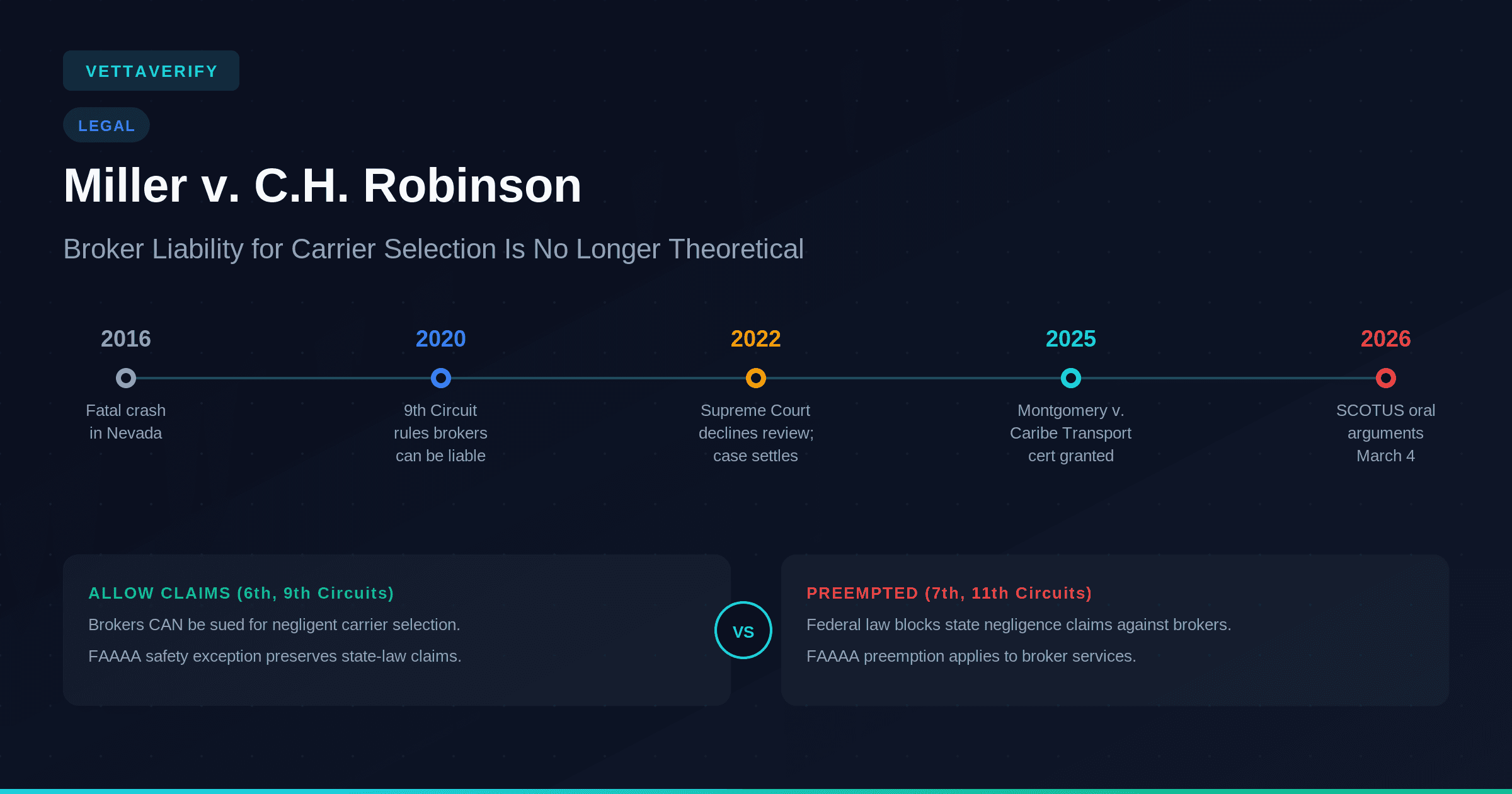
Summary: In 2020, the Ninth Circuit ruled in Miller v. C.H. Robinson that freight brokers can be sued for negligently selecting carriers — the FAAAA's safety exception preserves those state-law claims. The Supreme Court declined review, and C.H. Robinson settled (Miller was left a quadriplegic). Now the Supreme Court is directly addressing the question in Montgomery v. Caribe Transport II, with oral arguments heard March 4, 2026, and a ruling expected by summer 2026. The circuit courts are split — the 6th and 9th allow these claims, the 7th and 11th say they're preempted. Regardless of the outcome, the regulatory direction (Kowalski Act, SAFER Transport Act, FMCSA enforcement) is raising the standard of care. Small brokers should establish written vetting criteria, document every carrier decision, monitor carriers continuously after onboarding, and maintain records that would survive legal discovery.
For most of the modern era of freight brokerage, brokers operated under a comfortable legal assumption: if a carrier you hired caused an accident, that was the carrier's problem, not yours. You arranged the shipment. The carrier moved it. Liability followed the truck, not the broker.
That assumption started cracking in 2020. It may shatter entirely by summer 2026.
The case that changed everything was Miller v. C.H. Robinson Worldwide, Inc. And the case that could settle the question for good — Montgomery v. Caribe Transport II, LLC — had its oral arguments before the U.S. Supreme Court on March 4, 2026.
If you run a freight brokerage of any size, you need to understand both cases, what they mean for your liability exposure, and what you should be doing right now regardless of how the Supreme Court rules.
The Case That Started It All: Miller v. C.H. Robinson
In December 2016, Allen Miller was driving near Elko, Nevada, when a semi-tractor trailer lost control, crossed the median, and collided with his vehicle. Miller was pinned under the trailer and suffered catastrophic injuries that left him a quadriplegic.
The truck was operated by a carrier called RT Service, which had been hired by C.H. Robinson to haul a shipment for Costco. C.H. Robinson's role was purely that of a freight broker — it didn't own the truck, employ the driver, or control the shipment's movement. It arranged the transportation.
Miller sued C.H. Robinson, alleging that the brokerage had a duty to select a competent carrier and that it was negligent in hiring RT Service. Miller's argument was that C.H. Robinson knew or should have known about the carrier's safety record, including a history of violations and an out-of-service rate roughly twice the national average.
The Legal Question: Does Federal Law Protect Brokers?
C.H. Robinson's defense relied on the Federal Aviation Administration Authorization Act of 1994 (FAAAA) — a federal law that, despite its name, governs motor carriers and freight brokers. The FAAAA includes a preemption clause that prohibits states from enacting or enforcing laws "related to a price, route, or service" of brokers with respect to property transportation. In other words, it was supposed to prevent a patchwork of state regulations from burdening interstate commerce.
The district court in Nevada agreed with C.H. Robinson. The judge ruled that Miller's negligence claim was preempted by the FAAAA because allowing it would effectively require every broker to inspect every carrier's background — creating a state-level standard of care that federal law was designed to prevent.
Miller appealed. And the Ninth Circuit reversed.
The Ninth Circuit's Ruling
The Ninth Circuit Court of Appeals — which covers Alaska, Arizona, California, Hawaii, Idaho, Montana, Nevada, Oregon, and Washington — agreed that Miller's negligence claim was "related to" C.H. Robinson's services. But it held that the district court got it wrong on a critical point: the FAAAA's safety exception.
The FAAAA includes a carve-out stating that its preemption provisions don't restrict "the safety regulatory authority of a State with respect to motor vehicles." The Ninth Circuit ruled that this safety exception preserves states' ability to regulate safety through common-law tort claims, including negligence. And because Miller's claim arose from a motor vehicle accident, it had the required connection to motor vehicle safety.
The bottom line: in the Ninth Circuit's view, a freight broker can be sued under state law for negligently selecting a carrier that causes an accident. Federal preemption doesn't block that claim because the safety exception applies.
C.H. Robinson petitioned the Supreme Court to review the case. The Court declined in June 2022, leaving the Ninth Circuit's ruling intact as binding law in the western United States. The case subsequently settled.
Why It Matters Beyond the Ninth Circuit
Even though the Miller ruling technically only binds courts in the nine western states under the Ninth Circuit's jurisdiction, its practical impact has been much broader. Plaintiffs' attorneys across the country have cited Miller in negligent carrier selection claims. Some district courts in other circuits have followed its reasoning. And the core legal theory — that brokers owe a duty of reasonable care in selecting carriers — has become a standard argument in freight accident litigation.
The Miller case established that a broker's safety record data was publicly available on FMCSA websites, and that a broker that failed to review this data before hiring a carrier could be considered negligent. The carrier in Miller had documented safety problems. The question was whether the broker had a legal obligation to check — and the Ninth Circuit said yes.
The Supreme Court Steps In: Montgomery v. Caribe Transport
Because federal circuit courts split on the question — the Sixth and Ninth Circuits allowed negligent selection claims against brokers, while the Seventh and Eleventh Circuits held they were preempted — the issue was destined for the Supreme Court.
That case is Montgomery v. Caribe Transport II, LLC.
The Facts
In 2017, Shawn Montgomery was parked on the shoulder of an Illinois highway when a tractor-trailer driven by a Caribe Transport II employee veered off the road and struck his vehicle. Montgomery suffered severe, permanent injuries.
The shipment was arranged by C.H. Robinson under a broker-carrier agreement with Caribe. Montgomery sued both the carrier and the broker, alleging that C.H. Robinson negligently selected a carrier whose driver had been involved in a prior crash months earlier and was still employed.
The district court held that the negligent hiring claim against C.H. Robinson was related to broker services but fell within the FAAAA's safety exception — meaning it was not preempted. However, the Seventh Circuit reversed, ruling that the claim was preempted.
Montgomery appealed to the Supreme Court, which granted certiorari in October 2025 to resolve the circuit split.
Oral Arguments: March 4, 2026
The Supreme Court heard oral arguments on March 4, 2026, and the case has drawn extraordinary attention. Amazon, the U.S. Chamber of Commerce, the Solicitor General, TIA, and numerous other industry stakeholders filed amicus briefs — a signal of just how consequential the ruling will be.
The core legal question is the same one from Miller: does the FAAAA's preemption clause bar state-law negligent selection claims against brokers, or does the safety exception preserve them?
Montgomery's attorney, Paul Clement, argued that Congress intended to deregulate the economics of trucking but deliberately preserved state safety regulations for motor vehicles — and that state negligent hiring torts have traditionally been used against both carriers and brokers.
C.H. Robinson and the United States government argued the opposite: that broker carrier selection is a "service" that falls squarely under the FAAAA's preemption clause, and that the safety exception only applies to entities that actually own or operate motor vehicles — not to brokers who arrange transportation.
Several justices probed the practical implications of both positions. If brokers can be sued for negligent carrier selection, would they be forced to only hire large, well-established carriers — effectively shutting smaller carriers out of the market? Conversely, if brokers have no liability, what incentive do they have to vet carriers for safety at all?
What Happens Next
The Court is expected to issue its ruling before the summer recess in late June or early July 2026. Until then, the legal landscape remains uncertain — but the trend is clear. Whether the Supreme Court upholds or strikes down broker liability for negligent carrier selection, the industry is moving toward higher vetting standards regardless.
The Regulatory Convergence
The Miller/Montgomery legal thread isn't happening in isolation. It's converging with legislative pressure from multiple directions.
The Kowalski Act would fine brokers 10% of cargo value for contracting with carriers that have three or more DOT violations. Unlike the court cases, which involve personal injury claims after accidents, the Kowalski Act creates direct regulatory penalties for poor carrier selection — with or without an accident.
The SAFER Transport Act requires FMCSA to develop automated fraud detection systems, phases out MC numbers, and mandates ownership change notifications — all of which assume that brokers should be using carrier data to make informed vetting decisions.
And FMCSA's own enforcement actions — the MOTUS registration system, the chameleon carrier crackdown, the CDL mill shutdowns — all signal a regulatory environment where the expectation of broker due diligence is becoming codified, not just suggested.
The collective message from Congress, the courts, and the regulators is unmistakable: if you broker freight, you're responsible for knowing who's hauling it. The only question is how that responsibility is enforced — through lawsuits, legislation, regulation, or all three.
What This Means for Small Brokerages
Here's the hard truth: regardless of how the Supreme Court rules in Montgomery, the practical risk for small brokerages has already changed.
If the Court allows negligent selection claims, brokers in every state will face potential liability for hiring carriers with documented safety issues. Plaintiffs' attorneys already have the Miller playbook. The case law will be national, not regional.
If the Court rules that these claims are preempted, it doesn't make carrier vetting optional. Legislative proposals like the Kowalski Act create alternative enforcement mechanisms. FMCSA's increasing focus on registration integrity and fraud detection means the regulatory floor is rising. And shippers are increasingly requiring documented vetting processes from their brokers as a condition of doing business.
Either way, the standard of care is moving in one direction: up.
What "Reasonable Care" Actually Looks Like
If you're a small brokerage trying to figure out what "reasonable care" in carrier selection means — what would hold up in court or satisfy a regulatory audit — here's a practical framework.
Check the publicly available data. This is the minimum. FMCSA provides safety records, inspection histories, crash data, authority status, and insurance information for every registered carrier. The Miller case specifically noted that this data was accessible to brokers. Not checking it when it's freely available is the definition of negligence.
Establish written vetting criteria. Define what makes a carrier acceptable, flagged, or rejected — and base those criteria on objective data points. Authority age, out-of-service rates, violation frequency, insurance status, crash history, and fleet size are all defensible factors. Document the criteria and apply them consistently.
Document every decision. Every carrier you approve, flag, or reject should have a timestamp, a record of the data reviewed, and a notation of the rationale. If you override your own criteria — booking a carrier that's flagged because you need to cover a load — document why. "We needed someone" is not a defense. "The carrier's OOS rate was elevated but their last 12 months showed improvement, their insurance was current, and we verified driver identity" is.
Our guide to detecting double brokering covers the specific warning signs to watch for.
Monitor carriers after onboarding. A carrier's safety profile isn't static. Authority can be revoked, insurance can lapse, safety ratings can change, and ownership can transfer. The fact that a carrier passed your vetting process six months ago doesn't mean they'd pass it today. Continuous monitoring — automated alerts when a carrier in your network experiences a material change — closes the gap between onboarding and the next load.
Keep records that would survive discovery. If a negligent selection claim is filed against your brokerage, the plaintiff's attorney will request your carrier selection records. They'll want to see what you checked, when you checked it, what criteria you used, and whether you followed your own process. If those records don't exist, the assumption will be that you didn't do the work. If they do exist and they're thorough, they're your best defense.
How VettaVerify Supports Defensible Carrier Selection
This is the environment VettaVerify was built for. The platform creates exactly the kind of documented, data-driven carrier vetting process that the legal and regulatory landscape is increasingly demanding.
Every carrier profile in VettaVerify is built from real-time FMCSA data — census records, inspection history, crash data, insurance status, authority information, and fleet composition — synced daily and tracked for changes. VettaScore provides a composite risk rating that weighs dozens of factors, giving brokers a defensible, data-backed assessment of every carrier they consider.
Custom assessment criteria let brokers define their own vetting standards — minimum authority age, maximum OOS rates, required insurance levels — and apply them consistently across every carrier. Per-carrier overrides are supported but documented, creating the kind of auditable decision trail that holds up under legal scrutiny.
The "Needs Attention" queue automatically surfaces carriers in your network whose profiles have changed — authority revocations, insurance lapses, safety rating downgrades, contact information shifts — so you're never in the position of having booked a load with a carrier whose status deteriorated without your knowledge.
For small brokerages without a dedicated compliance team, VettaVerify turns carrier vetting from an ad-hoc process into a systematic, documented, defensible workflow. Whether the Supreme Court expands broker liability or Congress codifies new standards, having the right process in place now means you're prepared either way.
The carriers who cause the worst accidents tend to leave data trails long before the crash. The brokers who avoid liability are the ones who read those trails and act on them. VettaVerify makes both parts — reading the data and acting on it — practical for a brokerage of any size.
VettaVerify provides the documented, data-driven carrier vetting workflow that the legal and regulatory environment increasingly demands. Real-time FMCSA data, VettaScore risk ratings, custom assessment criteria, automated change monitoring, and full audit trails — starting at $59/month. See how it works.