Every freight broker has a horror story. A carrier that looked clean on paper disappears with a $40,000 load of electronics. An "established" trucking company turns out to be a chameleon carrier operating under a freshly minted MC number. A double-broker slips through the cracks, and now you're on the hook for a claim you never should have touched.
These aren't edge cases anymore. They're becoming the norm.
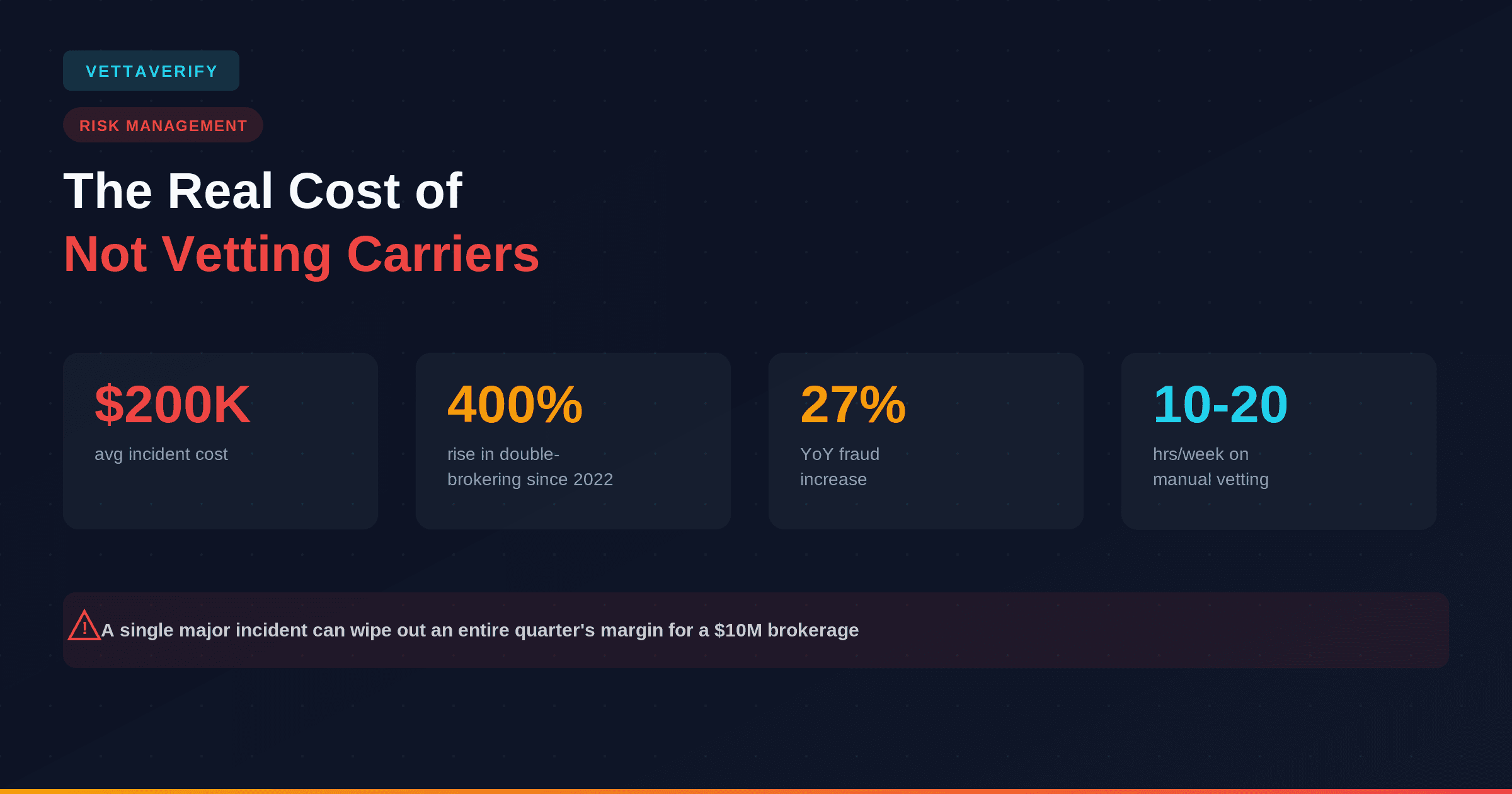
Fraudulent freight activity has surged 27% year-over-year, and double-brokering reports have climbed more than 400% since 2022. For brokerages running lean teams without enterprise budgets, the question isn't whether you'll encounter fraud — it's whether you'll catch it before it costs you.
The Direct Financial Hit
The most obvious cost of poor carrier vetting is the one that shows up on your balance sheet. The average double-brokering incident costs a brokerage roughly $200,000 when you factor in the load value, legal fees, insurance deductibles, and the time your team spends cleaning up the mess.
For a brokerage doing $10M in annual revenue, a single major incident can wipe out an entire quarter's margin. Two incidents in a year? That's an existential threat.
But the direct losses are only the beginning. Insurance premiums ratchet up after claims. Shippers start asking harder questions about your vetting process. And every hour your team spends on damage control is an hour they're not moving freight.
The Regulatory Landscape Is Shifting
The freight industry's regulatory environment is tightening, and brokers who rely on gut checks and outdated processes are increasingly exposed.
The landmark Miller v. C.H. Robinson ruling established that brokers can be held liable for accidents involving carriers they select — a legal standard that puts your carrier selection process directly under the microscope. If you can't demonstrate a rigorous, documented vetting workflow, you're carrying liability risk on every load you book.
Then there's the proposed Kowalski Act, which would formalize broker liability for negligent carrier selection and mandate specific vetting standards. Whether or not the bill passes in its current form, the direction is clear: regulators expect brokers to know who they're handing freight to. "We checked their MC number" isn't going to cut it.
The Hidden Costs Nobody Talks About
Beyond the big-ticket losses and regulatory exposure, poor vetting creates a slow bleed of operational costs that most brokerages never quantify.
Time waste. How many hours per week does your team spend manually checking FMCSA SAFER records, calling insurance companies, and chasing down carrier packets via email and fax? For most small brokerages, it's somewhere between 10 and 20 hours per week — the equivalent of a half-time employee doing nothing but Googling DOT numbers.
Opportunity cost. Every minute spent on manual verification is a minute not spent building shipper relationships, negotiating rates, or scaling your book of business. The brokerages that grow fastest aren't necessarily the ones with the biggest teams — they're the ones that spend their time on revenue-generating activities instead of administrative busywork.
Decision fatigue. When vetting is manual and inconsistent, your team is making judgment calls on every carrier, every load. Some dispatchers are cautious to a fault, rejecting carriers that are perfectly safe. Others are too lenient, waving through carriers that should have raised flags. Without a standardized, data-driven process, your risk exposure is essentially random.
Retention. Good ops people don't stick around at brokerages where they spend half their day doing tedious compliance work. They leave for companies with modern tooling and streamlined workflows.
What "Good Enough" Vetting Looks Like in 2026
Five years ago, checking a carrier's authority status and insurance on FMCSA SAFER was considered due diligence. That bar has moved significantly.
A defensible vetting process in 2026 should include real-time authority and insurance monitoring — not a one-time check at onboarding, but continuous surveillance for lapses, changes, and red flags. It should incorporate safety performance data like out-of-service rates, violation history, and crash trends, not just whether a carrier has an active MC number.
You should be cross-referencing contact information against FMCSA records to catch identity theft and chameleon carriers. Geographic anomalies matter too — a carrier registered in Florida with all their inspections in Oregon deserves a closer look. And all of this needs to be documented in a way that demonstrates your process if a regulator or attorney ever comes knocking.
None of this is revolutionary. It's just hard to do manually at scale, especially when you're a 10-person brokerage trying to compete with the top 100.
The Math on Automation
Here's the simple calculation most brokerages haven't done.
Take the cost of a single fraud incident — conservatively, $50,000 for a moderate case. Now take the cost of a carrier vetting platform — typically somewhere between $50 and $350 per month depending on your team size and feature needs.
That means a year of automated vetting costs less than a single bad load. Factor in the time savings from automated monitoring, self-service carrier onboarding, and digital agreements, and the ROI isn't even close.
The brokerages that figured this out early aren't just avoiding losses. They're onboarding carriers faster, booking loads with more confidence, and spending their time on growth instead of compliance paperwork.
The Bottom Line
The freight industry has a fraud problem, and it's getting worse. Regulatory pressure is increasing. The legal standard for "reasonable" carrier selection is rising. And the tools to meet that standard are more accessible and affordable than ever.
The real cost of not vetting carriers isn't just the occasional bad load. It's the cumulative drag on your operations, your growth, and your peace of mind. In 2026, the brokerages that treat carrier vetting as a strategic investment — rather than an administrative chore — are the ones that will still be around in 2027.